
Table of Contents
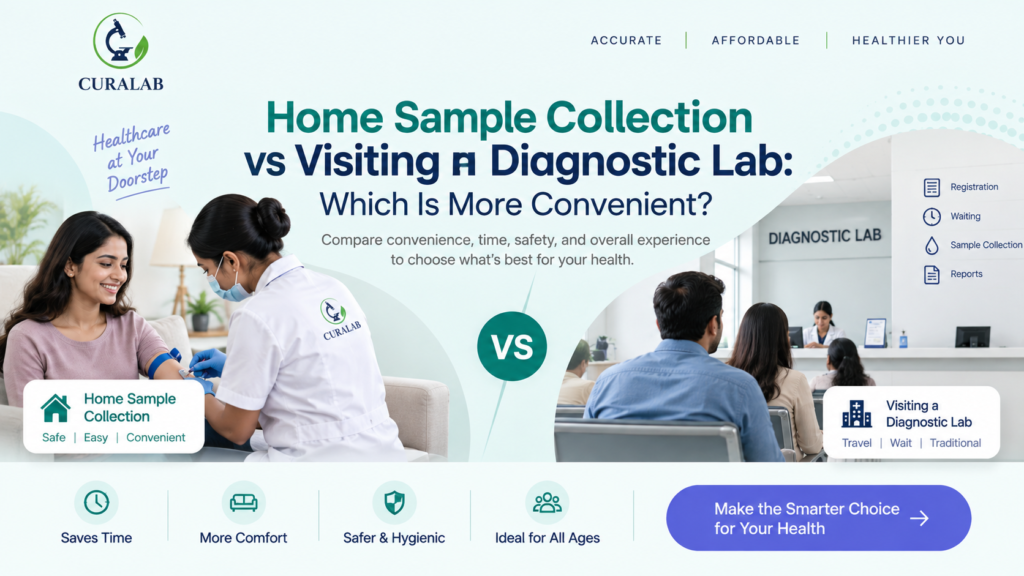
Home Sample Collection vs Visiting a Diagnostic Lab: Which Is More Convenient?
Home sample collection has become an increasingly popular option for people who need routine blood tests and other diagnostic investigations without visiting a laboratory in person. Instead of travelling to a diagnostic centre, patients can schedule an appointment and have a trained phlebotomist or healthcare professional collect the required sample at their home.
But does home sample collection really offer more convenience than visiting a diagnostic lab?
The answer depends on several factors, including the type of test, your schedule, mobility, location, turnaround time, and personal preferences.
Traditional diagnostic labs still offer an important advantage: they provide a dedicated environment where samples can be collected and, depending on the facility, certain tests or procedures can be performed under the same roof. On the other hand, home sample collection can eliminate travel and waiting time, making routine testing easier for many people.
This guide compares home sample collection with visiting a diagnostic lab so you can understand how both options work and decide which approach may suit your situation.
What Is Home Sample Collection?
Home sample collection is a diagnostic service in which a trained healthcare professional visits your home to collect a sample required for laboratory testing.
Depending on the test, the sample may include:
Blood
Urine
Stool
Other specimens where home collection is appropriate
The collected sample is then transported to a diagnostic laboratory for processing and analysis.
The exact collection process depends on the test and the diagnostic provider. Some tests may require fasting, specific preparation, medication adjustments, or collection at a particular time.
Before scheduling home sample collection, patients should confirm the preparation instructions provided by the laboratory or healthcare professional.
For general information about laboratory testing and preparation, the MedlinePlus guide to medical tests provides patient friendly information about different types of diagnostic tests.
Why Is Home Sample Collection Becoming Popular?
Convenience is one of the biggest reasons people choose home sample collection.
Consider a person who needs a routine blood test.
The traditional process may involve waking up early, travelling to a diagnostic lab, finding parking, registering at the facility, waiting for the collection process, and then travelling back home or to work.
With home sample collection, much of that travel can be eliminated.
The healthcare professional comes to the patient’s location at the scheduled time, collects the sample, and leaves.
For people with busy schedules, this can make diagnostic testing easier to fit into everyday life.
However, convenience should not be confused with suitability.
Some diagnostic procedures cannot be performed through simple home sample collection, and certain tests may require specialized equipment available only at a laboratory or medical facility.
Home Sample Collection vs Visiting a Diagnostic Lab
Both options have advantages and limitations.
The easiest way to understand the difference is to look at the most important factors.
1. Travel and Transportation
Home sample collection has a clear advantage when it comes to travel.
You do not have to arrange transportation to the laboratory, spend time commuting, or find parking.
This can be particularly useful for people who have limited mobility, elderly family members, individuals recovering from illness, parents with young children, or people working from home.
Visiting a diagnostic lab, on the other hand, requires you to travel to the facility.
For someone who lives close to a laboratory, this may not be a significant inconvenience.
For someone living far away or in an area with heavy traffic, the difference can be considerable.
2. Waiting Time
Another important factor is waiting.
A diagnostic lab may have multiple patients arriving at the same time. Depending on the facility and appointment system, you may need to wait before your sample is collected.
Home sample collection can reduce this part of the process because the appointment is scheduled for your location.
However, the actual appointment time can still be affected by travel delays, scheduling issues, or unexpected circumstances.
Therefore, home sample collection can reduce waiting and travel, but it does not necessarily guarantee an exact collection time.
3. Comfort and Privacy
For some people, getting a sample collected at home can feel more comfortable.
You are in a familiar environment rather than a clinical waiting area.
This can be particularly useful for people who feel anxious about visiting healthcare facilities.
Home sample collection may also be convenient for families who need testing for multiple members.
Instead of taking everyone to a diagnostic lab, a collection professional may be able to collect samples at home according to the provider’s procedures.
However, the quality of the experience depends heavily on the professionalism of the collection service.
4. Convenience for Elderly and Mobility Limited Patients
Home sample collection can be especially useful for people who find travelling difficult.
Older adults, people recovering from surgery or illness, and individuals with mobility limitations may find travelling to a diagnostic centre physically demanding.
In such situations, bringing the collection service to the patient’s home can reduce unnecessary travel.
The healthcare provider should still determine whether home collection is appropriate for the required test.
Convenience should never override clinical requirements.
5. Test Availability
This is one area where visiting a diagnostic lab may be more practical.
Not every diagnostic test can be completed through home sample collection.
Routine blood and urine tests may commonly be suitable for home collection, depending on the provider.
However, certain specialized investigations, imaging procedures, functional tests, or procedures requiring specialized equipment may require a visit to a diagnostic facility.
Before booking home sample collection, confirm that the specific test you need is available through the service.
You can also ask whether the sample will be processed at the provider’s main laboratory or another facility.
6. Sample Handling and Transportation
Sample handling is an important part of laboratory testing.
Once a sample is collected at home, it may need to be labelled correctly, stored under appropriate conditions, and transported to the laboratory within the required timeframe.
Diagnostic providers should have established procedures for sample identification, handling, and transportation.
When choosing a provider, patients can ask how samples are transported and how they maintain sample integrity.
This is one reason it is important to use a reputable diagnostic service rather than choosing a provider based only on convenience or price.
The World Health Organization’s laboratory quality guidance highlights the importance of quality systems and proper laboratory processes.
7. Fasting and Test Preparation
Some diagnostic tests require preparation before sample collection.
For example, your healthcare provider may ask you to fast for a specific period before certain blood tests.
Other tests may require particular timing or instructions.
Home sample collection can make fasting easier for some people because they do not have to travel while waiting for their appointment.
You can wake up, follow the required preparation instructions, and have the sample collected at home.
However, always follow the instructions provided by your healthcare professional or diagnostic laboratory.
Do not assume that every blood test requires fasting.
8. Cost Comparison
Cost is another factor worth considering.
Home sample collection may involve an additional collection or service fee depending on the diagnostic provider.
Some providers offer free home collection for selected tests or locations, while others may charge separately.
Visiting a diagnostic lab may therefore be cheaper in some situations.
However, the true cost of a diagnostic test is not necessarily just the laboratory fee.
Consider the time and expense associated with transportation, parking, missed work, or arranging assistance.
For someone who needs to take time off work to visit a laboratory, home sample collection may provide practical value even if the collection service costs slightly more.
9. Convenience for Busy Professionals
People with demanding work schedules may find home sample collection particularly convenient.
Instead of spending part of the morning travelling to a diagnostic lab, they can schedule sample collection at home around their routine.
This can reduce disruption to work and daily responsibilities.
However, appointment availability matters.
If the home collection service has limited time slots, the convenience advantage may be smaller.
Before booking, check the available collection windows and estimated report delivery time.
10. Home Sample Collection for Families
Families may also benefit from home sample collection.
Imagine that several members of a household need routine testing.
Travelling to a diagnostic lab with children, elderly parents, or multiple family members can become complicated.
A home collection appointment may simplify the process by allowing samples to be collected at one location.
However, each individual’s test requirements should be confirmed beforehand.
When Visiting a Diagnostic Lab May Be More Convenient
Home sample collection is not automatically the most convenient option in every situation.
Visiting a diagnostic lab may make more sense when:
You need specialized testing
The test requires equipment available at the facility
You need imaging
You require an in person medical procedure
The laboratory is very close to your home
You need testing that is not available through home collection
You prefer completing everything at one diagnostic centre
For some patients, visiting the facility can actually be faster than waiting for a home collection appointment.
Convenience depends on circumstances, not just the location of the sample collection.
When Home Sample Collection May Be More Convenient
Home sample collection may be particularly useful when:
You have limited time
You have difficulty travelling
You are caring for children or elderly family members
You work from home
You want to avoid unnecessary travel
You live far from the diagnostic centre
You require routine blood or urine testing that the provider offers for home collection
You prefer being tested in a familiar environment
In these situations, the ability to have a trained professional visit your home can simplify the diagnostic process.
How to Choose a Reliable Home Sample Collection Service
Convenience should not be your only consideration.
Before booking home sample collection, consider the following:
Check the Diagnostic Provider
Choose a recognized diagnostic provider with established laboratory facilities and appropriate quality processes.
Confirm the Test
Make sure the specific test you need is available through home collection.
Ask About Preparation
Confirm whether fasting, hydration, medication instructions, or other preparation is required.
Check Collection Charges
Ask whether home collection involves an additional fee.
Confirm Report Timelines
Find out when and how you will receive your reports.
Ask About Sample Transportation
Understand how samples are labelled, handled, and transported to the laboratory.
Verify the Collector
A trained and qualified healthcare professional should perform the collection.
Home Sample Collection and Digital Healthcare
Another advantage of modern home sample collection is the integration of digital services.
Many diagnostic providers now allow patients to book appointments online, receive confirmation messages, access reports digitally, and manage diagnostic information through websites or mobile applications.
This can reduce the administrative effort involved in testing.
The entire process can potentially look like this:
Book the test online
Select home collection
Choose an appointment time
Complete the required preparation
Healthcare professional collects the sample
Sample is transported to the laboratory
Laboratory processes the sample
Report becomes available digitally
This is one reason home sample collection fits naturally into the broader movement toward convenient and digitally connected healthcare.
Does Home Sample Collection Affect Test Accuracy?
A common concern is whether collecting a sample at home affects the accuracy of laboratory results.
The answer depends on the specific test and, importantly, on proper collection, handling, storage, transportation, and laboratory processing.
Home collection itself does not automatically mean that a test is less reliable.
However, improper preparation or sample handling can potentially affect results.
That is why patients should follow collection instructions carefully and choose a diagnostic provider with appropriate procedures for sample handling and transportation.
If you have concerns about whether a particular test can be collected at home, ask your healthcare provider or laboratory before booking.
Which Option Is More Convenient?
There is no universal answer.
For routine tests that are available through home collection, home sample collection can be highly convenient because it eliminates travel and may reduce waiting time.
For specialized procedures or tests requiring equipment available at a diagnostic facility, visiting a laboratory may be necessary.
The most practical choice depends on your test, location, schedule, mobility, preparation requirements, and the services offered by your diagnostic provider.
Final Thoughts
The comparison between home sample collection vs visiting a diagnostic lab is ultimately about matching the testing process to your circumstances.
Home sample collection can save travel time, reduce logistical challenges, provide greater comfort, and make routine testing easier for busy individuals and people who have difficulty travelling.
Visiting a diagnostic lab can provide access to specialized equipment, broader testing services, and procedures that cannot be performed through simple home collection.
Neither option is automatically better for every person.
The right choice depends on the type of diagnostic test you need and the services available from a qualified healthcare provider.
If you are considering home sample collection, confirm the test requirements, preparation instructions, collection charges, sample handling procedures, and expected report timeline before booking.
Convenience matters, but so do safety, quality, and appropriate medical care.Home sample collection has become an increasingly popular option for people who need routine blood tests and other diagnostic investigations without visiting a laboratory in person. Instead of travelling to a diagnostic centre, patients can schedule an appointment and have a trained phlebotomist or healthcare professional collect the required sample at their home.
But does home sample collection really offer more convenience than visiting a diagnostic lab?
The answer depends on several factors, including the type of test, your schedule, mobility, location, turnaround time, and personal preferences.
Traditional diagnostic labs still offer an important advantage: they provide a dedicated environment where samples can be collected and, depending on the facility, certain tests or procedures can be performed under the same roof. On the other hand, home sample collection can eliminate travel and waiting time, making routine testing easier for many people.
This guide compares home sample collection with visiting a diagnostic lab so you can understand how both options work and decide which approach may suit your situation.
What Is Home Sample Collection?
Home sample collection is a diagnostic service in which a trained healthcare professional visits your home to collect a sample required for laboratory testing.
Depending on the test, the sample may include:
Blood
Urine
Stool
Other specimens where home collection is appropriate
The collected sample is then transported to a diagnostic laboratory for processing and analysis.
The exact collection process depends on the test and the diagnostic provider. Some tests may require fasting, specific preparation, medication adjustments, or collection at a particular time.
Before scheduling home sample collection, patients should confirm the preparation instructions provided by the laboratory or healthcare professional.
For general information about laboratory testing and preparation, the MedlinePlus guide to medical tests provides patient friendly information about different types of diagnostic tests.
Why Is Home Sample Collection Becoming Popular?
Convenience is one of the biggest reasons people choose home sample collection.
Consider a person who needs a routine blood test.
The traditional process may involve waking up early, travelling to a diagnostic lab, finding parking, registering at the facility, waiting for the collection process, and then travelling back home or to work.
With home sample collection, much of that travel can be eliminated.
The healthcare professional comes to the patient’s location at the scheduled time, collects the sample, and leaves.
For people with busy schedules, this can make diagnostic testing easier to fit into everyday life.
However, convenience should not be confused with suitability.
Some diagnostic procedures cannot be performed through simple home sample collection, and certain tests may require specialized equipment available only at a laboratory or medical facility.
Home Sample Collection vs Visiting a Diagnostic Lab
Both options have advantages and limitations.
The easiest way to understand the difference is to look at the most important factors.
1. Travel and Transportation
Home sample collection has a clear advantage when it comes to travel.
You do not have to arrange transportation to the laboratory, spend time commuting, or find parking.
This can be particularly useful for people who have limited mobility, elderly family members, individuals recovering from illness, parents with young children, or people working from home.
Visiting a diagnostic lab, on the other hand, requires you to travel to the facility.
For someone who lives close to a laboratory, this may not be a significant inconvenience.
For someone living far away or in an area with heavy traffic, the difference can be considerable.
2. Waiting Time
Another important factor is waiting.
A diagnostic lab may have multiple patients arriving at the same time. Depending on the facility and appointment system, you may need to wait before your sample is collected.
Home sample collection can reduce this part of the process because the appointment is scheduled for your location.
However, the actual appointment time can still be affected by travel delays, scheduling issues, or unexpected circumstances.
Therefore, home sample collection can reduce waiting and travel, but it does not necessarily guarantee an exact collection time.
3. Comfort and Privacy
For some people, getting a sample collected at home can feel more comfortable.
You are in a familiar environment rather than a clinical waiting area.
This can be particularly useful for people who feel anxious about visiting healthcare facilities.
Home sample collection may also be convenient for families who need testing for multiple members.
Instead of taking everyone to a diagnostic lab, a collection professional may be able to collect samples at home according to the provider’s procedures.
However, the quality of the experience depends heavily on the professionalism of the collection service.
4. Convenience for Elderly and Mobility Limited Patients
Home sample collection can be especially useful for people who find travelling difficult.
Older adults, people recovering from surgery or illness, and individuals with mobility limitations may find travelling to a diagnostic centre physically demanding.
In such situations, bringing the collection service to the patient’s home can reduce unnecessary travel.
The healthcare provider should still determine whether home collection is appropriate for the required test.
Convenience should never override clinical requirements.
5. Test Availability
This is one area where visiting a diagnostic lab may be more practical.
Not every diagnostic test can be completed through home sample collection.
Routine blood and urine tests may commonly be suitable for home collection, depending on the provider.
However, certain specialized investigations, imaging procedures, functional tests, or procedures requiring specialized equipment may require a visit to a diagnostic facility.
Before booking home sample collection, confirm that the specific test you need is available through the service.
You can also ask whether the sample will be processed at the provider’s main laboratory or another facility.
6. Sample Handling and Transportation
Sample handling is an important part of laboratory testing.
Once a sample is collected at home, it may need to be labelled correctly, stored under appropriate conditions, and transported to the laboratory within the required timeframe.
Diagnostic providers should have established procedures for sample identification, handling, and transportation.
When choosing a provider, patients can ask how samples are transported and how they maintain sample integrity.
This is one reason it is important to use a reputable diagnostic service rather than choosing a provider based only on convenience or price.
The World Health Organization’s laboratory quality guidance highlights the importance of quality systems and proper laboratory processes.
7. Fasting and Test Preparation
Some diagnostic tests require preparation before sample collection.
For example, your healthcare provider may ask you to fast for a specific period before certain blood tests.
Other tests may require particular timing or instructions.
Home sample collection can make fasting easier for some people because they do not have to travel while waiting for their appointment.
You can wake up, follow the required preparation instructions, and have the sample collected at home.
However, always follow the instructions provided by your healthcare professional or diagnostic laboratory.
Do not assume that every blood test requires fasting.
8. Cost Comparison
Cost is another factor worth considering.
Home sample collection may involve an additional collection or service fee depending on the diagnostic provider.
Some providers offer free home collection for selected tests or locations, while others may charge separately.
Visiting a diagnostic lab may therefore be cheaper in some situations.
However, the true cost of a diagnostic test is not necessarily just the laboratory fee.
Consider the time and expense associated with transportation, parking, missed work, or arranging assistance.
For someone who needs to take time off work to visit a laboratory, home sample collection may provide practical value even if the collection service costs slightly more.
9. Convenience for Busy Professionals
People with demanding work schedules may find home sample collection particularly convenient.
Instead of spending part of the morning travelling to a diagnostic lab, they can schedule sample collection at home around their routine.
This can reduce disruption to work and daily responsibilities.
However, appointment availability matters.
If the home collection service has limited time slots, the convenience advantage may be smaller.
Before booking, check the available collection windows and estimated report delivery time.
10. Home Sample Collection for Families
Families may also benefit from home sample collection.
Imagine that several members of a household need routine testing.
Travelling to a diagnostic lab with children, elderly parents, or multiple family members can become complicated.
A home collection appointment may simplify the process by allowing samples to be collected at one location.
However, each individual’s test requirements should be confirmed beforehand.
When Visiting a Diagnostic Lab May Be More Convenient
Home sample collection is not automatically the most convenient option in every situation.
Visiting a diagnostic lab may make more sense when:
You need specialized testing
The test requires equipment available at the facility
You need imaging
You require an in person medical procedure
The laboratory is very close to your home
You need testing that is not available through home collection
You prefer completing everything at one diagnostic centre
For some patients, visiting the facility can actually be faster than waiting for a home collection appointment.
Convenience depends on circumstances, not just the location of the sample collection.
When Home Sample Collection May Be More Convenient
Home sample collection may be particularly useful when:
You have limited time
You have difficulty travelling
You are caring for children or elderly family members
You work from home
You want to avoid unnecessary travel
You live far from the diagnostic centre
You require routine blood or urine testing that the provider offers for home collection
You prefer being tested in a familiar environment
In these situations, the ability to have a trained professional visit your home can simplify the diagnostic process.
How to Choose a Reliable Home Sample Collection Service
Convenience should not be your only consideration.
Before booking home sample collection, consider the following:
Check the Diagnostic Provider
Choose a recognized diagnostic provider with established laboratory facilities and appropriate quality processes.
Confirm the Test
Make sure the specific test you need is available through home collection.
Ask About Preparation
Confirm whether fasting, hydration, medication instructions, or other preparation is required.
Check Collection Charges
Ask whether home collection involves an additional fee.
Confirm Report Timelines
Find out when and how you will receive your reports.
Ask About Sample Transportation
Understand how samples are labelled, handled, and transported to the laboratory.
Verify the Collector
A trained and qualified healthcare professional should perform the collection.
Home Sample Collection and Digital Healthcare
Another advantage of modern home sample collection is the integration of digital services.
Many diagnostic providers now allow patients to book appointments online, receive confirmation messages, access reports digitally, and manage diagnostic information through websites or mobile applications.
This can reduce the administrative effort involved in testing.
The entire process can potentially look like this:
Book the test online
Select home collection
Choose an appointment time
Complete the required preparation
Healthcare professional collects the sample
Sample is transported to the laboratory
Laboratory processes the sample
Report becomes available digitally
This is one reason home sample collection fits naturally into the broader movement toward convenient and digitally connected healthcare.
Does Home Sample Collection Affect Test Accuracy?
A common concern is whether collecting a sample at home affects the accuracy of laboratory results.
The answer depends on the specific test and, importantly, on proper collection, handling, storage, transportation, and laboratory processing.
Home collection itself does not automatically mean that a test is less reliable.
However, improper preparation or sample handling can potentially affect results.
That is why patients should follow collection instructions carefully and choose a diagnostic provider with appropriate procedures for sample handling and transportation.
If you have concerns about whether a particular test can be collected at home, ask your healthcare provider or laboratory before booking.
Which Option Is More Convenient?
There is no universal answer.
For routine tests that are available through home collection, home sample collection can be highly convenient because it eliminates travel and may reduce waiting time.
For specialized procedures or tests requiring equipment available at a diagnostic facility, visiting a laboratory may be necessary.
The most practical choice depends on your test, location, schedule, mobility, preparation requirements, and the services offered by your diagnostic provider.
- Why Do You Feel Tired All the Time? 10 Powerful Health Conditions Doctors May Check
- Home Sample Collection vs Visiting a Diagnostic Lab: Which Is More Convenient In 2026?
- Regular Health Checkups: Why They Matter Even When You Feel Completely Healthy
- Home Sample Collection in Karnal: 7 Powerful Benefits and How It Works
- Complete Blood Count in Karnal: 7 Powerful Reasons to Get a CBC Test
Final Thoughts
The comparison between home sample collection vs visiting a diagnostic lab is ultimately about matching the testing process to your circumstances.
Home sample collection can save travel time, reduce logistical challenges, provide greater comfort, and make routine testing easier for busy individuals and people who have difficulty travelling.
Visiting a diagnostic lab can provide access to specialized equipment, broader testing services, and procedures that cannot be performed through simple home collection.
Neither option is automatically better for every person.
The right choice depends on the type of diagnostic test you need and the services available from a qualified healthcare provider.
If you are considering home sample collection, confirm the test requirements, preparation instructions, collection charges, sample handling procedures, and expected report timeline before booking.
Convenience matters, but so do safety, quality, and appropriate medical care.
Frequently Asked Questions About Home Sample Collection
What is home sample collection?
Home sample collection is a diagnostic service where a trained healthcare professional visits your home to collect samples such as blood, urine, or other specimens that are suitable for laboratory testing. The sample is then transported to a diagnostic laboratory for processing.
Is home sample collection more convenient than visiting a diagnostic lab?
Home sample collection can be more convenient for people who want to avoid travel, waiting rooms, and transportation. However, visiting a diagnostic lab may be more suitable for specialized tests or procedures that require equipment available at the laboratory.
Are blood tests available through home sample collection?
Many routine blood tests can be performed through home sample collection, depending on the diagnostic provider and the specific test. Patients should confirm availability and preparation requirements before scheduling an appointment.
How does home sample collection work?
You typically book a home collection appointment, follow any preparation instructions provided by the laboratory, and have a trained healthcare professional collect the required sample at your home. The sample is then labelled, transported, and processed by the diagnostic laboratory.
Do I need to fast before home sample collection?
Some tests may require fasting, while others do not. Fasting requirements depend on the specific test. Always follow the preparation instructions provided by your healthcare provider or diagnostic laboratory rather than assuming that fasting is required.
Does home sample collection affect test accuracy?
Home collection does not automatically make a test less accurate. Proper sample collection, identification, storage, transportation, and laboratory processing are important for reliable results. Choosing a reputable diagnostic provider can help ensure appropriate sample handling.
Is home sample collection suitable for elderly patients?
Home sample collection can be particularly convenient for elderly patients or people who have difficulty travelling. It can reduce the need for transportation and allow routine samples to be collected in a familiar environment when the required test is available for home collection.
Are there additional charges for home sample collection?
Additional charges depend on the diagnostic provider, location, test package, and collection service. Some providers may offer free home collection for selected tests, while others may charge a separate collection fee. Check the total cost before booking.
Can all diagnostic tests be done through home sample collection?
No. Some specialized tests, imaging procedures, and investigations require equipment or facilities available only at a diagnostic laboratory or medical centre. Confirm with the diagnostic provider whether your specific test is available through home collection.
How should I choose a home sample collection service?
Look for a reputable diagnostic provider with trained collection professionals, appropriate sample handling procedures, transparent pricing, reliable reporting, and clear instructions for test preparation. You should also confirm whether the specific test you need is available through home collection.
How long does it take to receive reports after home sample collection?
The reporting time depends on the type of test, laboratory processing requirements, and diagnostic provider. Routine tests may be available relatively quickly, while specialized investigations can take longer. Ask the laboratory for the expected report timeline when booking.
Can I book home sample collection online?
Many diagnostic providers allow patients to book home sample collection through their website, mobile application, or other digital booking systems. Availability depends on the provider and the location where the collection is requested.